








































Agricultural Research Scientist, Professor Roger Kanton, has raised concerns over the sustainability of farming in Ghana, warning that current food prices are too low to support farmers’ livelihoods despite increasing production.
He stressed that while consumers may benefit from affordable food, the prices at which farmers are selling their produce make it difficult for them to cover costs, invest in quality inputs, or earn a fair incom.
Currently, food inflation decreased from 9.5% to 6.6% by October 2025. This is a notable improvement from the 22.8% recorded at the same time last year.
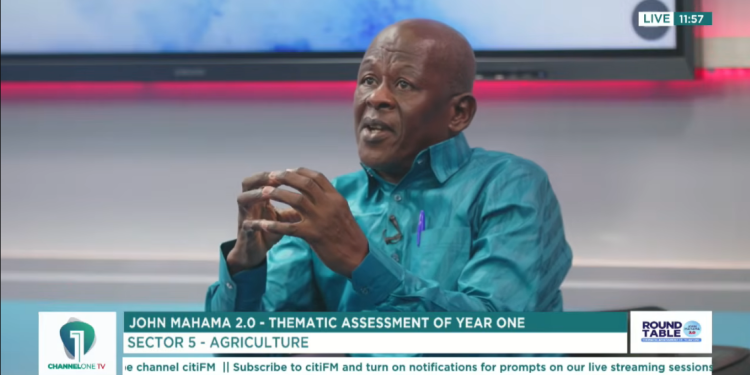
Speaking at a Roundtable Discussion organised by Channel One TV on “John Mahama 2.0: A Thematic Assessment of Year One” on Tuesday, January 13, 2026, Prof Kanton highlighted the disparity between market prices for maize and the rising cost of agricultural inputs such as fertiliser.
“When you pick maize, Ghana has the cheapest prices of maize on the global market. When you take Sissala, for example, it produces the best maize for the country. But the price of a bag of maize, which is 100kg, started from about GH¢220 ($20.51). As I speak today, you will be lucky to sell a bag at GH¢280. It is still hovering around GH¢240–GH¢250, which is so bad,” he said.
He contrasted this with the high cost of fertiliser, noting that the best brand, Yara Fertiliser, currently sells for between GH¢500 and GH¢590 per bag.
“This tells you that you may need to sell three bags of maize before you can buy one bag of fertiliser. So it is unfair to sit in Accra and jubilate when the prices are down,” he stressed.
Prof Kanton called for a balance between food production and the livelihood of farmers, advocating for an “optimal price” that ensures food remains affordable for consumers while providing farmers with a sustainable income.
“So, there should be a balance between food production with the livelihood of the farmer in mind, such that there will be an optimal price, such that people can afford the food, and at the same time, the farmer can also get a source of income. So, food prices are too low for the farmers,” he concluded.
SOURCE: citinewsroom.com

