































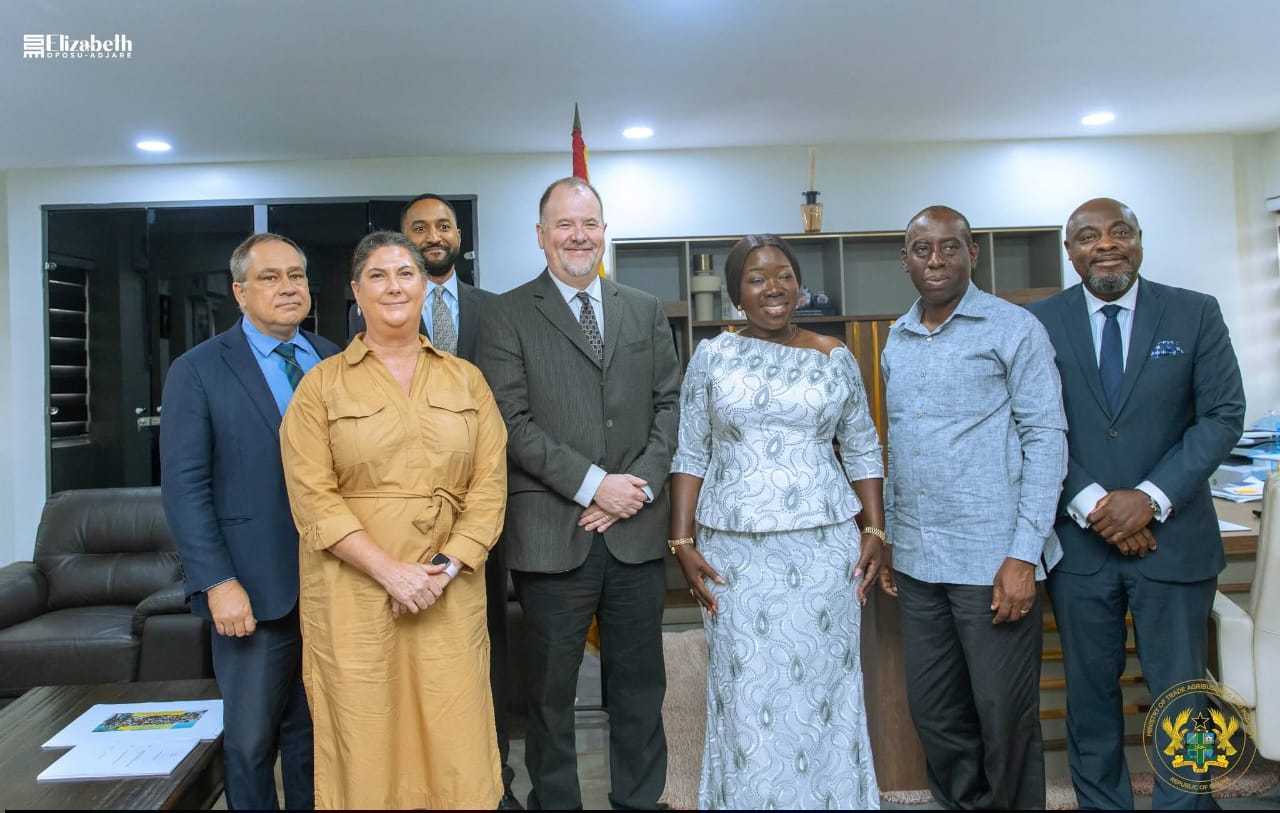
The Minister for Trade, Agribusiness and Industry, Hon. Elizabeth Ofosu-Adjare, has reaffirmed Ghana’s commitment to deepening trade and investment ties with the United States following high-level discussions with the Chargé d’Affaires of the United States Embassy in Ghana, Rolf Olson, on the implementation of the recently extended African Growth and Opportunity Act (AGOA).
The courtesy call which took place on February 26, 2026, focused on Ghana’s strategic posture under the 15-month AGOA extension window and explored areas of bilateral cooperation to maximise export gains while aligning advocacy priorities with the U.S. Embassy.
Mr. Olson explained that although widely described as a one-year extension, the renewal effectively runs for 15 months — from October 1, 2025, through December 31, 2026 — following its retroactive application.
He indicated that under the current U.S. administration, there is strong emphasis on commercial engagement and expanding market access for American companies, noting that future trade engagements are expected to reflect a more reciprocal approach.
While acknowledging the benefits of AGOA over the past 25 years, Mr. Olson stated that discussions going forward would consider opportunities for U.S. businesses to access foreign markets in return for continued preferential access to the American market.
He also referenced ongoing developments in U.S. tariff policy, explaining that while AGOA preferences remain intact, a 15 per cent benchmark tariff has been announced under a different legal provision following recent judicial developments in the United States. He emphasised that AGOA-eligible products would continue to benefit from duty-free access under the programme.

Minister Ofosu-Adjare welcomed the extension and commended the U.S. for its continued advocacy of AGOA, noting that when American officials speak in support of the programme, it strengthens confidence in the partnership.
She underscored the transformative impact of AGOA on Ghana’s garment and textile industry, stating that a single garment factory can employ up to 5,000 people, many of them women. According to her, the sector provides decent and inclusive employment, including opportunities for pregnant women and young mothers.
The Hon. Minister stressed that sustaining competitiveness in textiles and garments remains critical, warning that additional tariff burdens could undermine job creation, particularly in emerging industrial enclaves outside Accra.
She further emphasised that AGOA contributes to addressing irregular migration by creating employment opportunities locally, adding that expanded economic prospects in Ghana and Africa reduce the incentive for risky migration.
On Ghana’s eligibility under AGOA, Mr. Olson noted that governance standards and business dispute resolution remain important criteria in Washington’s periodic assessments. He raised concerns about outstanding payments owed to some U.S. entities, explaining that unresolved arrears to American companies attract attention in Washington and could affect perceptions of the investment climate.
In response, Hon. Minister Ofosu-Adjare acknowledged that inherited financial obligations were undergoing scrutiny, adding that once verified as legitimate, appropriate payment arrangements could be established. She reaffirmed Ghana’s commitment to honouring just debts and maintaining its reputation as a stable democracy with strong governance credentials.
The meeting also addressed public procurement practices. Mr. Olson encouraged broader use of competitive tendering processes to enable U.S. companies to participate in bids, noting that sole-sourcing arrangements limit options and competition.
The Hon. Minister agreed that competitive tendering provides value for money but explained that, in certain urgent circumstances, sole-sourcing is permitted under the law to address pressing national needs.
Mr. Olson disclosed that the U.S. Export-Import Bank has reinstated short-term private sector financing facilities, describing it as a development linked to Ghana’s recent macroeconomic progress. He expressed optimism that the reopening of this facility could facilitate purchases of U.S. goods and services, particularly for infrastructure and private sector expansion.
Hon. Minister Ofosu-Adjare welcomed the development, stating that access to patient financing remains a key constraint for Ghanaian industry. She emphasised the need for clear communication to ensure that the private sector fully understands and utilises available financing mechanisms.
The discussions also touched on agricultural trade. The U.S. side highlighted high tariffs on certain agricultural imports used as industrial inputs, including wheat and corn, suggesting that tariff barriers restrict market access for American producers.
Hon. Minister Ofosu-Adjare indicated that such issues would form part of future discussions, reiterating Ghana’s openness to dialogue aimed at achieving mutually beneficial outcomes.
Hon. Minister Ofosu-Adjare described the bilateral relationship as one built on decades of cooperation across trade, education, health and social services, expressing confidence that future negotiations would remain fair and mutually respectful.
Mr. Olson indicated that further communication from the Office of the United States Trade Representative is expected regarding discussions on reciprocal trade arrangements, after which formal dialogue processes would be initiated.
The engagement signals a shared commitment to sustaining Ghana–U.S. trade relations while navigating evolving global trade dynamics under the extended AGOA window.

