















































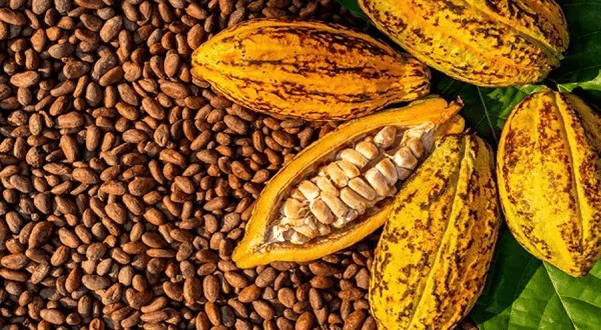
Government’s planned commercial paper programme for the cocoa sector is expected to attract strong domestic and offshore demand, although analysts say its success will depend on competitive pricing and renewed investor confidence in COCOBOD.
Fixed income analysts, speaking during a Markets Pulse session hosted by the Ghana Fixed Income Market (GFIM), said the proposed financing programme represents an important step in diversifying funding sources for Ghana Cocoa Board (COCOBOD) but cautioned that prevailing market conditions and investor perceptions will play a significant role in determining demand.
The comments come as COCOBOD prepares to introduce a tranche-based commercial paper programme ahead of the 2026/2027 cocoa season to reduce financing costs, broaden domestic participation in cocoa financing and reduce reliance on offshore syndicated loans that have traditionally funded annual cocoa purchases.
According to COCOBOD Deputy Chief Executive for Finance and Administration, Ato Boateng, the financing structure is at an advanced stage following engagement with transaction advisers and regulators.
The programme will allow the cocoa regulator to raise funds incrementally rather than borrowing an entire season’s financing requirement upfront. Officials say this approach will improve liquidity management by allowing COCOBOD to draw down only the funds required for cocoa purchases and repay investors as export proceeds become available.
Analysts believe the structure could appeal to a broad pool of investors, including pension funds, commercial banks and international investors, seeking shorter-duration exposure to Ghana’s debt market.
One analyst said offshore investors are showing considerable interest because the proposed instrument will provide access to a one-year yield-bearing security – a segment that has historically been unavailable to foreign investors.
“From an appetite perspective, I think there’s so much appetite from an offshore perspective,” he said, noting that investors are attracted by both the relatively short tenor opportunity to participate in Ghana’s domestic market.
However, he stressed that pricing will determine whether that interest translates into strong subscriptions.
“If the secondary market is trading similar papers around 14 percent, then something coming up the shelf should also look something similar,” he said, adding that the proposed issuance’s tenor and structure will also need to be reflected in pricing.
The analyst noted that commercial banks could also become significant buyers because the instrument will provide an additional investment option alongside Treasury bills, Open Market Operation (OMO) bills and government bonds.
Another market participant said local investors have welcomed efforts to introduce alternative financing instruments for the cocoa sector, but warned that confidence remains fragile following the Domestic Debt Exchange Programme (DDEP).
He observed that some investors who held COCOBOD bills before the debt restructuring are still awaiting repayment after choosing not to participate in the exchange programme.
“That did not give COCOBOD too much good publicity when coming back to the market to issue again,” he said, arguing that rebuilding investor trust will be critical to achieving a successful issuance.
He also pointed to the recent rise in domestic interest rates as another consideration.
When government issued its recent seven-year domestic bond, yields were relatively lower. Since then Treasury bill rates have climbed, making earlier bond pricing appear less attractive.
“I do not know whether that will also be priced-in… these are all things that we’ll consider,” he said.
The observations come against a backdrop of changing conditions in Ghana’s fixed income market.
Analysts noted that the sharp decline in Treasury bill yields during the first quarter has reversed, with the 364-day bill rising from about 9.84 percent at start of the second quarter to 12.82 percent by end-June.
Demand for Treasury securities has also moderated. Tendered bids fell to about GH¢70billion during the second quarter from GH¢164billion in the first quarter, narrowing the gap between investor demand and the Ministry of Finance’s issuance target.
Market participants attributed the shift to changing expectations for monetary policy after the Bank of Ghana paused its rate-cutting cycle and adjusted the Cash Reserve Ratio, prompting investors to demand higher yields and shift funds into alternative investments.
Brokerage firms also reported a migration of liquidity from fixed income assets into equities following a series of initial public offerings and strong gains on the Ghana Stock Exchange.
Analysts said returns of around 70 percent on some listed equities had encouraged fund managers and pension funds to rebalance portfolios away from Treasury securities.
Those dynamics could influence demand for the proposed COCOBOD paper, particularly if investors compare returns across competing asset classes.
Global cocoa prices have added fresh uncertainty to COCOBOD’s financing outlook, rebounding more than 23 percent over the past month to about US$5,000 per tonne after heavy rains in Ivory Coast raised concerns over flooding, disease and lower bean quality. Adverse weather across West Africa has also tightened supply expectations, reversing an earlier price slump driven by projections of a global surplus.
Analysts said higher cocoa prices could strengthen export earnings and support repayment under COCOBOD’s proposed commercial paper programme. However, the same weather conditions threaten production – increasing the risk of lower output that could complicate the revolving financing model.
The commercial paper programme forms part of a broader cocoa financing overhaul.
For more than three decades, COCOBOD financed cocoa purchases through annual offshore syndicated loans of between US$1billion and US$1.5billion. The new revolving commercial paper programme, expected to raise about US$1billion in cedi-denominated instruments, aims to lower financing costs, deepen the domestic capital market and reduce foreign exchange risk.
Analysts however cautioned that execution risks remain, with COCOBOD carrying an estimated GH¢32billion in liabilities and cocoa output only beginning to recover after recent declines.
Beyond issuer-specific factors, analysts said investors will also watch broader macroeconomic developments – particularly the Bank of Ghana’s next monetary policy decision.
A pause or increase in the policy rate could keep money market yields elevated, requiring issuers – including COCOBOD – to offer more attractive returns to secure funding.
Despite those uncertainties, market participants broadly agree that the proposed commercial paper programme marks an important step in reshaping cocoa financing. Its success, they said, will depend not only on investor appetite but also whether COCOBOD can strike the right balance between competitive pricing, prudent funding costs and renewed market confidence.
The post Market sees strong appetite for COCOBOD bond but pricing will be key appeared first on The Business & Financial Times.

