


























Behind every smoked fish sold in Ghana’s markets is a story of resilience, sacrifice, and unwavering determination. For many women in coastal communities, fish smoking is more than an occupation, it is a lifeline that feeds families, educates children, and sustains entire households despite the many challenges involved.
In this episode of At the Table with Alberta Nana Akyaa Akosa, we journey to Atakyem, where we meet Auntie Aya, a 46-year-old fish processor whose life has revolved around the smoking oven for the past two decades. Her story reflects the strength of countless Ghanaian women who continue to build their families and communities through hard work, often with little recognition.
Auntie Aya is a mother of six children, including two sets of twins. Although the responsibility of raising such a large family is enormous, she has remained steadfast, relying on the fish-smoking business she inherited from her mother.
“I started this business with my mother about twenty years ago,” she says with pride. “Since then, this is all I have been doing.”
For Auntie Aya, fish smoking is more than a means of earning an income; it is a family tradition that has become the foundation of her household’s survival.
A Business Built on Patience
Every day begins with purchasing fresh fish directly from the seashore before the long and demanding process of smoking begins.
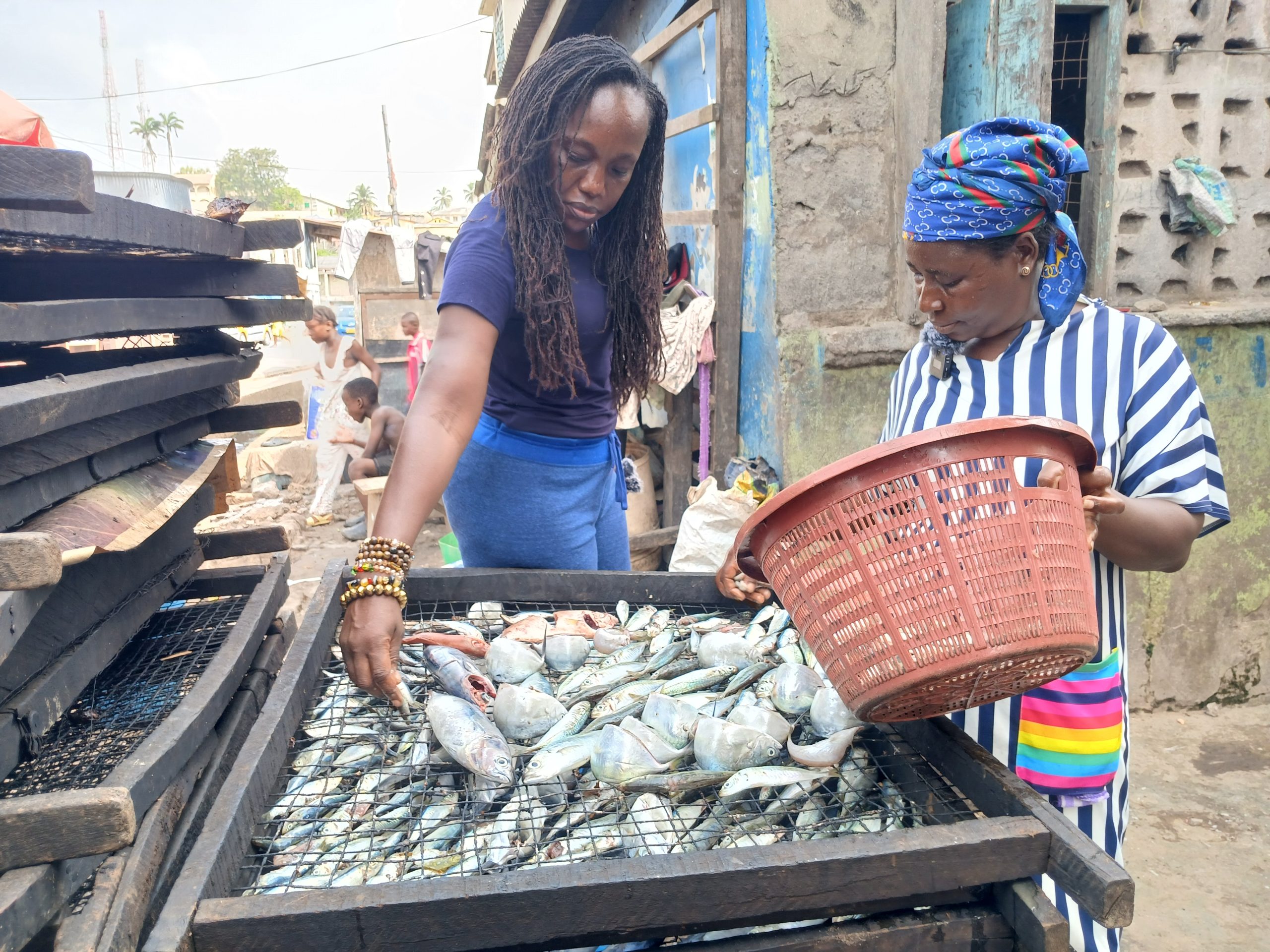
Unlike many modern industries that rely on automated equipment, fish smoking in her community remains largely manual. Every fish must be carefully arranged by hand on the smoking racks before being placed over the fire.
“It is really complicated,” she explains. “You have to patiently arrange the fish one by one. As those closest to the fire become ready, you replace them with the ones on top until everything is evenly smoked.”
The work requires concentration, endurance, and experience. Yet after twenty years, she continues the routine with remarkable commitment.
Interestingly, despite working around intense heat daily, she says serious finger burns are uncommon because they have mastered the technique of replacing the trays once the fish is properly smoked.
Turning Small Investments into Family Support
Like many small-scale entrepreneurs, Auntie Aya carefully manages every cedi she invests.
According to her, when business conditions are favourable, an investment of GHS 1,000 can generate a profit after expenses. However, profitability depends heavily on the price of fresh fish at the landing beach.
“Sometimes we make good profits,” she explains. “Other times, when fish becomes expensive at the shore, we incur losses.”
Despite these fluctuations, the business has consistently provided enough income to support her family.
“The money helps me take care of my children,” she says.
The proceeds from fish smoking have helped finance their education, provide daily necessities, and contribute to household expenses. She is also quick to acknowledge the support of her husband, noting that raising six children has been a shared responsibility.
“Their father has been very supportive,” she adds.
Although the income does not leave much room for significant investments or personal luxuries, ensuring her children’s education and well-being remains her greatest achievement.
Preserving a Family Legacy
Beyond earning a livelihood, Auntie Aya is passing valuable skills to the next generation.
Over the years, she has involved all her children in the business, teaching them every stage of fish processing—from arranging the fish on the smoking racks to selling the finished products.
“My children can do the work very well,” she says proudly. “Even if I’m not around, they can continue.”
Her sons and daughters alike have learned the trade, demonstrating that the skills required in fish processing can benefit anyone willing to learn.
For Auntie Aya, empowering her children with practical skills is another form of investment in their future.
Encouraging Others to Join
Despite the physical demands, Auntie Aya believes fish smoking remains a worthwhile business for anyone prepared to work hard.
She says she would gladly mentor anyone interested in entering the trade.
“I would explain everything to the person so they understand how to do it well and earn enough to support their family,” she says.
Her willingness to share her knowledge reflects the communal spirit often found among women working in Ghana’s informal food-processing sector.
The Need for Better Technology
One challenge that remains unresolved is the lack of improved processing equipment.
Currently, the traditional wooden smoking racks remain the primary tools available. Whenever one becomes worn out, it is simply replaced with another wooden structure.
Asked whether machines exist that could reduce the physical labour involved, Auntie Aya shakes her head.
“I have not seen any machine like that,” she says.
Her response highlights a broader challenge facing many women in Ghana’s fisheries value chain. Although they play a vital role in preserving fish for markets across the country, many continue to rely on traditional methods that demand significant physical effort and consume considerable time.
Access to improved smoking technologies could help increase productivity, reduce drudgery, improve product quality, and enhance incomes for women processors like Auntie Aya.
More Than a Business
As the interview draws to a close, one thing becomes abundantly clear: Auntie Aya’s story is not merely about smoked fish.
It is about perseverance.
It is about motherhood.
It is about entrepreneurship built from modest beginnings.
For twenty years, she has transformed fresh fish into income, challenges into opportunities, and hard work into hope for her children.
While she modestly describes herself as “managing” because there are few alternative jobs available, her journey represents much more. It demonstrates the resilience of women whose labour quietly sustains families, strengthens local food systems, and contributes significantly to Ghana’s economy.
Women like Auntie Aya may not often make headlines, but their daily efforts continue to nourish communities and build brighter futures—one smoked fish at a time.
At the Table with Alberta Nana Akyaa Akosa continues to spotlight such inspiring individuals, giving voice to the everyday heroes whose stories deserve to be heard and celebrated.
INTRODUCTION AT THE WITH ALBERTA NANA AKYAA AKOSA
This is “At the Table with Alberta Nana Akyaa Akosa” where we recognise and highlights the extraordinary and vital role women farmers and women farmers with disability are playing and shaping the future of food and the agri-food system.We are still in the Central Region for more discoveries from these amazing women. I am here with one beautiful and strong woman, a fish smoker and seller, who is contributing so much towards the fish processing sector within the fisheries value chain here in Elmina. Let’s hear her inspiring story.
Alberta Nana Akyaa Akosa – Auntie Aya! How are you doing?
Auntie AYA – I’M good by God’s grace
Alberta Nana Akyaa Akosa – I’m told here is known to be Atakyem
Auntie AYA – Yeah Atakyem
Alberta Nana Akyaa Akosa – So do you stay here?
Auntie AYA – Yes please
Alberta Nana Akyaa Akosa – How old do you say you are?
Auntie AYA – 46 years, please
Alberta Nana Akyaa Akosa – 46! and do you have children?
Auntie AYA – Yeah I have children
Alberta Nana Akyaa Akosa – so how many are the children?
Auntie AYA – I have two pairs twins and two others
Alberta Nana Akyaa Akosa – meaning they are six in all?
Auntie AYA – Yeah
Alberta Nana Akyaa Akosa – What work do you do?
Auntie AYA – AIl I do is this fish smoking business
Alberta Nana Akyaa Akosa – Can I help you?
Auntie AYA – Yeah
Alberta Nana Akyaa Akosa – You smoke fish?
Auntie AYA – Yeah
Alberta Nana Akyaa Akosa – Has it been that long since you started?
Auntie AYA – Yes please
Alberta Nana Akyaa Akosa – For..
Auntie AYA – For about 20 years now
Alberta Nana Akyaa Akosa – Meaning you started when you are about 26 years?
Auntie AYA – Yeah! I started with my mother
Alberta Nana Akyaa Akosa – You were doing it with your mother.. And is that what you’ve been doing till now?
Auntie AYA – Yes please
Alberta Nana Akyaa Akosa – Really?
Auntie AYA – Yeah
Alberta Nana Akyaa Akosa – so where do you get the fish from?
Auntie AYA – I buy from the sea shore
Alberta Nana Akyaa Akosa – oh okay.. Have you been making profits?
Have you been making profits being a woman doing this business?
Auntie AYA – It’s been moving well steadily
Alberta Nana Akyaa Akosa – How has it been helping you?
Auntie AYA – I could invest say Ghc 1000 into it and make a GHC1400 profit after expenses
Alberta Nana Akyaa Akosa – meaning you’ve been making profits?
Auntie AYA – Yeah, but sometimes incur loses too when the fish is expensive at the shore
Alberta Nana Akyaa Akosa – So how is the profits helping you?
Auntie AYA – that is what I use to cater for the children
Alberta Nana Akyaa Akosa – Is that what is helping you to fund the education of the six children and other areas?
Auntie AYA – Yeah and their father has been very supportive
Alberta Nana Akyaa Akosa – ..and it’s been helping you to cater for the house and all other things?
Auntie AYA – Yeah
Alberta Nana Akyaa Akosa – Have you done anything different out of the profit you’ve made aside taking care of the children?
Auntie AYA – the profit is not that much but primarily helping to cater for the children’s education and everything
Alberta Nana Akyaa Akosa – Have you set the fire already?
Auntie AYA – No.. I’m yet to do so
Alberta Nana Akyaa Akosa – Don’t you experience finger burns when smoking the fish?
Auntie AYA – We just remove it from the oven when it is done smoking and replace it with another so we don’t really experience finger burns
Alberta Nana Akyaa Akosa – But is it that difficult going about it?
Auntie AYA – Yeah,it is really complicated. Like you see now, we have to patiently arrange the fish one-by-one.
– You have to exchange the one on top for the lower when it ready until you finish
Alberta Nana Akyaa Akosa – And you’ve been doing this for twenty years?
Auntie AYA – Yeah
Alberta Nana Akyaa Akosa – Are you pleased with this business?
Auntie AYA – Hmm actually there’s no other job to do so we are managing it
Alberta Nana Akyaa Akosa – have introduced others into this business?
Auntie AYA – I have been doing it with my children and can even do it in my absence
Alberta Nana Akyaa Akosa – oh really? So they are have been doing it too?
Auntie AYA – Yeah they can do it very well and sell it as well, even including the boy
Alberta Nana Akosa Akosa – oh really?
Auntie AYA – Yeah
Alberta Nana Akyaa Akosa – so would you encourage any one interested in doing this business?
Auntie AYA -hmm yeah
Alberta Nana Akyaa Akosa – why would you motivte somebody?
Auntie AYA – I will help the person who wants to come into this business by explaining it for them to understand and operate it well to get something to cater for their family
Alberta Nana Akyaa Akosa – Is there any equipment that could help you do the work faster or it just this wooden tool?
Auntie AYA – Yeah, it’s just this one. We only have to replace it with a new one when it spoils.
Alberta Nana Akyaa Akosa – Is there not any machine that would minimize the stress?
Auntie AYA – I have not seen any machine of that sort.. It’s just this one
Alberta Nana Akyaa Akosa – Outro
This is “At The Table with Alberta Nana Akyaa Akosa” and I say cheers to all the women farmers and women farmers with disability who are nourishing our nations. Indeed they are the heart of the farm, they are the seed of the farm, they are the gold in the soil.
Source: AgriwatchGH

