
















































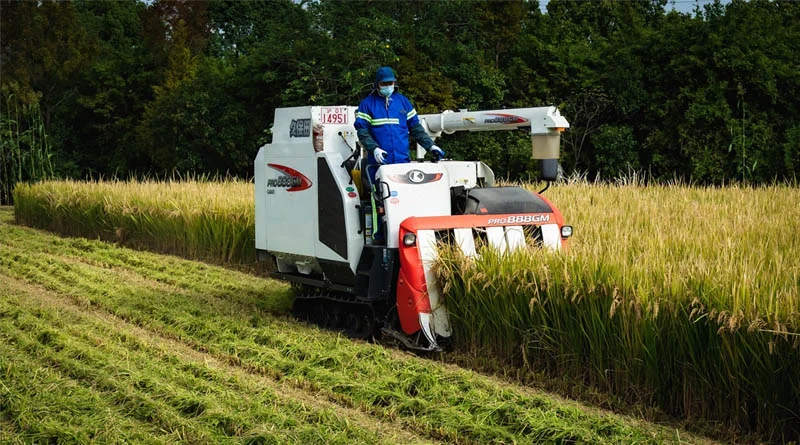
China’s top legislature, the Standing Committee of the National People’s Congress, adopted a new Farmland Protection Law on August 28, formalizing rules aimed at stopping the loss of arable land and tightening accountability for local officials responsible for meeting the country’s food security targets. The law takes effect on January 1, 2027.
The legislation reinforces China’s longstanding commitment to keeping at least 1.8 billion mu, or roughly 120 million hectares, of farmland under cultivation nationwide, a threshold known domestically as the farmland “red line” that has anchored Chinese agricultural policy for nearly two decades. Under the new law, farmland is designated primarily for producing grain, cotton, oilseed crops, sugar crops and vegetables, along with forage and feed crops, narrowing the scope for converting cultivated land to non-agricultural uses such as construction, forestry or ornamental landscaping.
A central feature of the law is an accountability system that ties farmland protection and food security performance directly to how officials are evaluated when they leave office, a mechanism Beijing has increasingly used across policy areas to enforce local compliance with national priorities that might otherwise be deprioritized in favor of faster-growing sectors like real estate or industrial development. The law also directs local governments to apply modern monitoring technology, including satellite remote sensing, big data analytics, cloud computing and artificial intelligence, to detect illegal land conversion and track farmland conditions more systematically than manual inspection allows.
Alongside the Farmland Protection Law, the same NPC Standing Committee session approved a revised Agriculture Law intended to strengthen government support for rural economic development more broadly, with details of that companion legislation released separately from the farmland measure.
The new law builds on several years of tightening enforcement around illegal farmland conversion, following widely reported cases in which local governments allowed cultivated land to be repurposed for non-farm uses in violation of central directives, sometimes to boost short-term local revenue. China’s Ministry of Agriculture and Rural Affairs reported in July that the country had cumulatively built more than one billion mu of what it calls “high-standard farmland,” meaning fields upgraded with irrigation, drainage and consolidation improvements, as part of a broader plan to reach 1.35 billion mu of such upgraded land by 2030.
Formalizing these protections into national law, rather than administrative directive alone, gives the policy more legal weight and makes it harder for local governments to sidestep through regulatory workarounds, a pattern Chinese policymakers have flagged as a persistent risk given the strong financial incentives local authorities have historically had to convert farmland for non-agricultural development.
SOURCE: GLOBAL AGRICULTURE

