










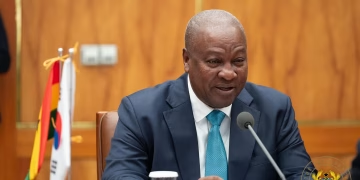




























The Minister for Food and Agriculture, Hon. Eric Opoku, has moved to reassure the public that Ghana is well-positioned to withstand the recent export ban on tomatoes imposed by Burkina Faso.
Speaking to journalists in Accra on Wednesday, March 25, the Minister dismissed concerns of a looming crisis, stating firmly that the government’s proactive agricultural policies have created a robust buffer for national demand.
Central to the government’s strategy is the “Feed Ghana” initiative, launched in 2025. Hon. Opoku revealed that the Ministry has already laid the groundwork by partnering with 81 specialized farming communities.
“This issue of shortage is not going to happen anywhere; we are putting in adequate measures to ensure we produce above national demand,” the Minister stated. He detailed an ambitious expansion plan for the current year:
To ensure these harvests reach consumers efficiently, the Minister highlighted the establishment of new processing centers and a dedicated farmers’ market located around the University of Ghana bypass, providing a direct link for citizens to purchase fresh produce.
A Call for “Backyard Resilience”
Beyond large-scale commercial farming, Hon. Opoku emphasized the role of the individual citizen in securing the national food basket. He urged Ghanaians to reclaim the culture of backyard gardening as a practical response to regional supply shifts.
“Tomatoes can be planted in our homes. Wherever you are, have a small garden to supplement household feeding,” he urged, noting that there is no better time than the present to intensify the campaign for domestic food self-sufficiency.
Despite the restrictions from neighboring Burkina Faso, the Ministry’s message remains clear: through the combination of the Feed Ghana expansion and local household participation, Ghana’s tomato supply remains secure and the situation “is not alarming.”

