



















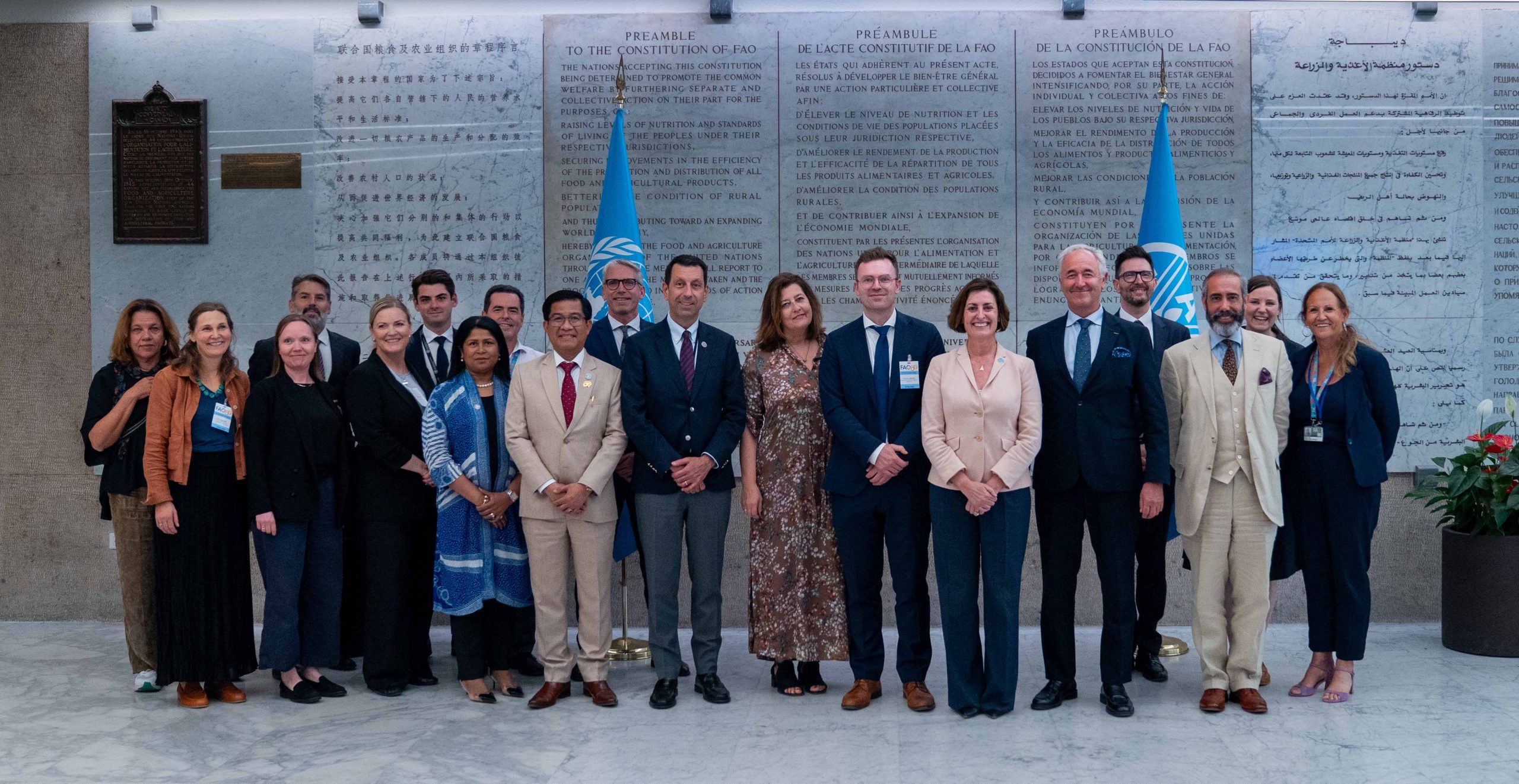
The annual consultation brought together senior representatives from FAO and across the Norwegian government for a candid and forward-looking discussion on global food security challenges, humanitarian pressures, climate shocks and the future of international cooperation at a time of growing strain on agrifood systems.
The discussions highlighted the importance of science- and evidence-based cooperation, strong multilateral institutions, and sustained investment in global public goods – including data and statistics, as well as standards that ensure fair trade and safeguard plant, animal, and human health.
Representatives from key Norwegian ministries and agencies participated in the consultation, underscoring the strategic importance Norway places on its partnership with FAO. The delegation was led by Erling Hess Johnsen, Deputy Director at the Norwegian Ministry of Foreign Affairs, who reaffirmed Norway’s strong commitment to food security and multilateral cooperation.
“Food security remains a strategic priority in Norway’s development policy and cooperation, together with health, education, economic empowerment, gender equality and women’s rights,” he said. “Norway sees FAO as a critical pillar in multilateral cooperation, with a normative mandate and operational activities of crucial importance.”
Deputy Director-General Beth Bechdol welcomed the delegation by recognizing Norway’s longstanding leadership in international development cooperation and its historic role within FAO.
“Norway has long been a deeply trusted and valued partner of FAO,” she said. “We share a strong commitment to science, evidence-based decision-making and multilateral cooperation at a moment when these principles matter enormously. Norway was also instrumental in shaping our Organization around a fundamental principle — that food security, agriculture and international cooperation are central to peace, stability and development.”
A key focus of the consultation was the role of agriculture in preventing and reducing prolonged food crises. Discussions highlighted the importance of protecting local food production and livelihoods in fragile and conflict-affected settings, alongside the value of anticipatory action and early intervention to help communities withstand shocks before they escalate into larger humanitarian crises.
Norway has been a leading contributor to FAO’s Special Fund for Emergency and Resilience Activities (SFERA), supporting anticipatory action, emergency agricultural assistance and livelihood protection in countries affected by conflict, climate shocks and natural disasters. Over the past three years alone, FAO’s partnership with Norway has helped reach more than 3 million people worldwide. Protection remains a core priority for Norway, including a strong focus on Prevention of Sexual Exploitation and Abuse (PSEA), and Norway welcomed the effective use of its recent SFERA contributions in this area, which built capacity and generated impact beyond the initial one-year funding period.
Among other highlights of the dialogue was recognition of the enduring impact of the EAF-Nansen Programme — the longest-running development programme in FAO’s history — which, for five decades, has supported countries in strengthening sustainable fisheries management, scientific research, and ocean governance through an ecosystem approach to fisheries.
The discussions also highlighted Norway’s global leadership in safeguarding agricultural biodiversity, exemplified by the Svalbard Global Seed Vault — a powerful expression of long-term international stewardship to protect the genetic resources underpinning the world’s food systems and future resilience.
FAO’s cooperation with Norway has helped strengthen key areas across agrifood systems while improving the lives and livelihoods of vulnerable rural communities. Norway has been a leading partner in the sustainable management of oceans and marine resources, climate-friendly and sustainable agrifood systems, land and forest management, and support for human rights, including those of Indigenous Peoples, gender equality and the right to food.
Following a wide-ranging review of joint achievements and shared priorities, both sides reaffirmed their commitment to deepening cooperation in the years ahead across resilient food production systems, fisheries management, climate resilience and emergency agricultural assistance. Building on more than 50 years of partnership, FAO and Norway emphasized the importance of practical, science-based cooperation and strong multilateral action to address increasingly complex global food security and agricultural challenges.

