







































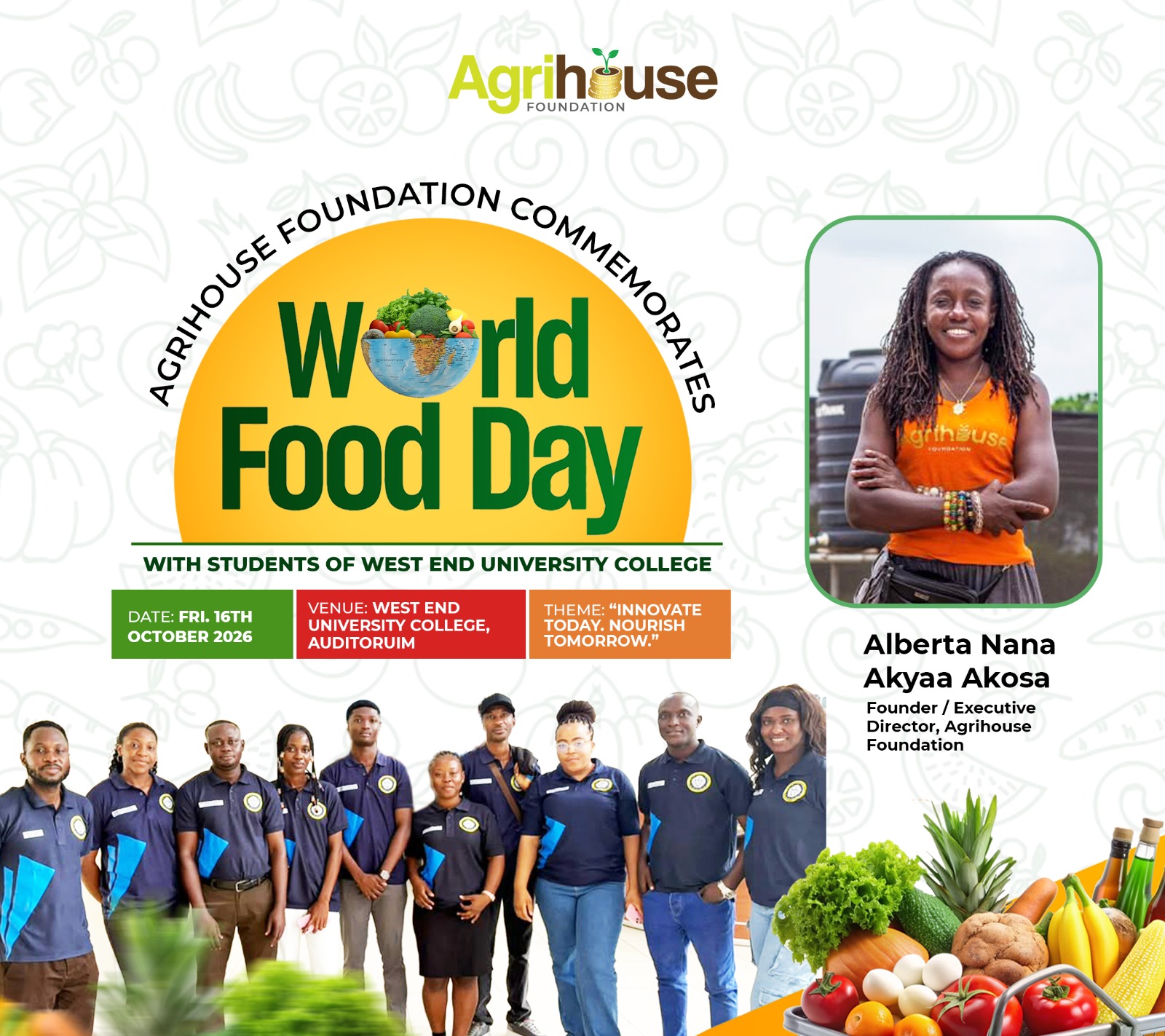

Agrihouse Foundation will be commemorating the World Food Day 2026 with students of West End University College, with a student-focused engagement aimed at strengthening young people’s understanding of food systems, promoting practical food production and inspiring greater interest in the future of agriculture.
Scheduled for Friday, October 16, on the university’s campus in Accra, the two-hour celebration will bring together students for an interactive programme combining food education, discussions on the origins of food and a practical school gardening demonstration.
The engagement aligns with this year’s global World Food Day theme, “Innovate today. Nourish tomorrow,” which highlights the role of science, technology and local knowledge in transforming agrifood systems and building a more food-secure future.
Organised globally by the Food and Agriculture Organization (FAO) of the United Nations, World Food Day draws attention to the importance of food security and the need for collective action to ensure that everyone has access to safe, nutritious and affordable food.
Against this backdrop, the Agrihouse Foundation and West End University College collaboration seeks to bring conversations about food production and sustainability closer to young people, encouraging students to see themselves not merely as consumers of food but also as potential contributors to agricultural innovation and food systems transformation.
Led by the Chief Operations Director for Agrihouse Foundation, a central feature of the celebration will be a session on “World Food Day: Where Does Our Food Come From?” The session is to help young people deep consider the origin of food and its basic production processes by encouraging students to reflect on the journey food takes from production to consumption, while drawing attention to the farmers, agricultural workers, technologies and processes that sustain food supplies.
The broader discussion would provide an opportunity to connect the global call to innovate with everyday experiences, helping students appreciate that transforming food systems requires more than producing enough food, but also strengthening the systems that enable people to access food reliably and affordably.
Although innovation is often associated with advanced machinery and digital technologies, the 2026 theme recognises a broader range of solutions, including improved agricultural practices, data systems, biotechnology, digital advisory services and local knowledge that helps communities respond to their specific food production challenges.
For young people, understanding these different forms of innovation can open up new perspectives on agriculture, including opportunities in research, agribusiness, technology, food processing and sustainable food production.
School Gardening: Turning Food Education into Action
Moving beyond classroom discussions, the celebration will feature a practical school gardening demonstration to be facilitated by renowned Agronomist, Mr. Aaron Amartey.
The demonstration will provide students with a hands-on introduction to food production and the role gardening can play in making agriculture more accessible within educational institutions and communities.
The activity reflects an important dimension of the World Food Day theme: innovation does not always begin with complex technology. It can also emerge from practical learning, locally appropriate solutions and the willingness to apply knowledge to everyday challenges.
By engaging students directly in a gardening demonstration, Agrihouse Foundation and West End University College are creating an opportunity to translate global conversations about food security and sustainable agriculture into an experience that young people can observe and learn from.
For Agrihouse Foundation, the collaboration offers a platform to advance food and agricultural awareness among young people, while demonstrating the value of connecting education with practical agricultural experiences.
As World Food Day is observed across the globe, the engagement at West End University College reinforces a message at the heart of this year’s theme: building a better food future requires fresh ideas, practical action and cooperation among people with different skills and experiences.
This year’s theme, “Innovate today. Nourish tomorrow” is a call to look beyond today’s food challenges and invest in the knowledge, people and solutions needed to create more sustainable and resilient agrifood systems for generations to come.