



































The Economic Commission for Africa (ECA) ECA has called on African countries and development partners to urgently close the financing gap for water and sanitation investments to accelerate sustainable development, climate resilience and economic transformation across the continent.
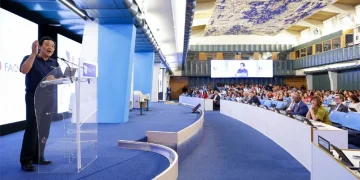
Speaking at a high-level side event on Financing Africa’s Water Investments during the African Development Bank Group 2026 Annual Meetings, Mr Claver Gatete, Executive Secretary of ECA commended the African Development Bank Group, the African Union Commission, the African Ministers’ Council on Water (AMCOW), and partners for convening what he described as a timely and strategic discussion on Africa’s water future.
He said the event came at a critical moment for the implementation of the Africa Water Vision 2063, which aims to achieve a water-secure and climate-resilient Africa with safe sanitation for all.
“The challenge is not a lack of solutions; it is about how we prioritise, finance and implement them at scale,” Mr Gatete said.
According to a press release , he noted that the discussions highlighted practical experiences, concrete pathways and the urgent need to translate ambition into action.
Mr Gatete placed Africa’s water challenges within the broader global context, noting that 2.2 billion people worldwide still lack safely managed drinking water, while 3.4 billion people lack safely managed sanitation.
In Africa alone, more than 400 million people do not have access to basic drinking water, while over 700 million remain without safely managed sanitation.
He warned that water-related investments continue to receive less than three per cent of global climate finance despite water being the primary channel through which climate impacts are experienced through droughts, floods and climate variability.
“This imbalance has created a growing disconnect between the scale of the risk and the scale of investment,” he said.
Mr Gatete stated that Africa requires more than US$50 billion annually to achieve Sustainable Development Goal Six (SDG 6) on clean water and sanitation, yet current investments range between US$12 billion and US$15 billion annually.
He stressed that the financing gap extends beyond the water sector and affects agriculture, energy, industry, urban development, public health and climate resilience.
“Underinvestment in water is not only a social concern but a structural economic constraint,” he added.
Mr Gatete called for a fundamental shift in how water is perceived in African economies, describing water not merely as a utility but as “the bloodstream of our economies,” supporting food systems, energy generation, industrial development, ecosystem integrity, public health and regional integration.
He further noted that water was central to unlocking Africa’s blue economy potential and should be treated as an investable asset capable of driving growth, creating jobs and strengthening resilience.
Outlining four priority areas for action, Mr Gatete urged governments to place water at the centre of economic policy and decision-making by integrating it into national development plans, fiscal strategies and investment frameworks.
He also called for stronger project preparation systems to develop a pipeline of bankable and investment-ready water projects, including innovative solutions such as wastewater reuse, nature-based systems and climate-resilient sanitation infrastructure.
Third, he emphasised the need to expand blended finance and risk-sharing instruments through platforms such as the African Water Facility to attract private sector investment and diversify financing sources.
He added that expanding fiscal space through stronger debt management and financing reforms would also be critical.
Mr Gatete further called for improved governance, credible data systems and accountability frameworks to ensure investments deliver measurable, inclusive and sustainable outcomes.
“The next phase must focus on turning the discussions into tangible results, including financed projects, stronger partnerships and improved access to water and sanitation for millions across Africa,” he urged.
Mr Gatete reaffirmed the ECA’s readiness to work with the African Development Bank, the African Union Commission, AMCOW, Regional Economic Communities and other partners to support the implementation of the Africa Water Vision 2063.
“Together, we can deliver for Africa,” he said.

