































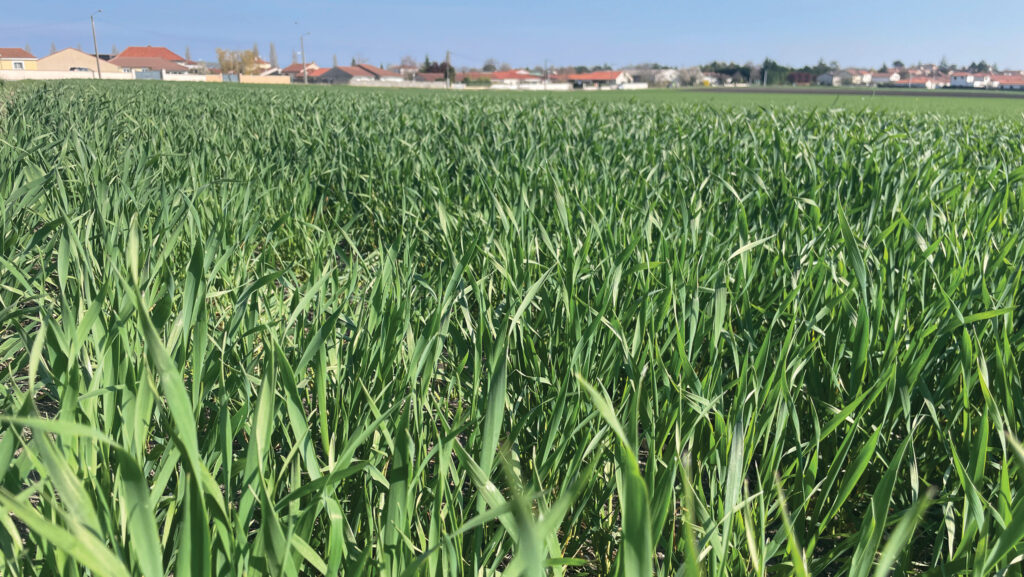
Like arable farmers in the UK, growers in central France are counting the high cost of climate change with reduced yields and the greater risk of crop failures.
But for members of a farmer co-op on the Limagne-Val d’Allier plain, solutions could become available in the next two years thanks to a major project.
The Limagrain co-op, parent company of the seed business familiar to UK farmers, is funding a major 12-year €7m (£6.1m) Matrix project which is trialling and testing solutions which incorporate more resilient crop varieties coming out of its breeding and seeds arm.
Local arable farmer and vice-chairman of vegetable seeds at Limagrain, Pierre-Antoine Rigaud says that climate change is becoming an increasing problem.
He points to last year where there was only 30mm of rain over the whole summer and three heatwaves with temperatures in the high 30Cs. They would normally see 100-150mm over the summer months.
From 1976-2018, when his dad managed the farm, there were three seasons affected by drought. But since Pierre-Antoine took over, there have already been four.
Heatwaves are a particular concern with the seed maize crops, as extreme temperatures can affect flowering and pollination.
Last year (2025) was the worst year since 2015, says Pierre-Antoine. He points to unirrigated maize for human consumption which yielded 3.8t/ha instead of the typical 8t/ha.
Seed crops were hit hard too, with 25% of maize seed production not producing a crop and 40% rejections.
“There was a big impact with the lack of revenue,” he says.
Looking to the future he says climate change is accelerating, with poor years becoming more frequent and he is concerned with seed maize crops.
However, he is confident that practical solutions will arise from the Matrix project along with new genetics, which will secure the farm’s future.
Changes already made
In the meantime, he has already made some changes: he has reduced soil cultivations by adopting direct drilling as well as growing cover crops – both to help conserve soil moisture.
In the local area, he says there is quite a range of cultivation systems with some farmers still ploughing and they in particular are seeing problems.
“They are going down a dead end road.” Pierre-Antoine has taken a direct drilling approach and has seen the benefits since he set out to move less soil, helping conserve moisture.
He typically sees 500mm rain a year, with 350-400mm over the winter.
After wheat and oilseed rape, he always grows a cover crop. Mixes over the years have included 5-6 different species including pulses (beans and peas), forage rye, radish and clover.
However, he recently stopped using forage rye before maize because of the slug problem and is planning to use barley or wheat instead.
He is also looking to increase soil organic matter. He farms volcanic black soil, some of which is quite light.
He is applying digestate, incorporates some straw and also does muck for straw deals with some local cattle farmers.
Cropping has also changed with sunflowers added to the rotation which are more resilient to dry conditions as seen in the Ukraine.
However, after this year, there will be no approved herbicides for the crop.

