











































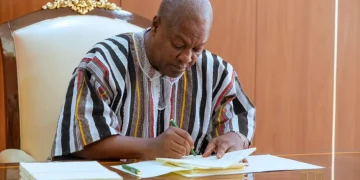







Professor Ebo Turkson, a Member of the Monetary Policy Committee (MPC) of the Bank of Ghana, has underscored that achieving economic stability comes at a cost.
He urged balanced discussions on policy trade-offs.
“We should always have a discussion relative to the benefits of the cost; every economic policy comes with a cost. Price stability comes at a cost,” he said.
Prof Turkson, an Associate Professor of Economics at the University of Ghana, speaking on TV3’s Key Points programme on Saturday, April 25, noted that every economic policy carries implications that must be weighed against its benefits.
He explained that the recent decline in inflation was largely due to the central bank’s intervention to absorb excess liquidity from the market.
“Inflation has gone down as a result of the central bank’s intervention to take liquidity out of the market,” he said.
Prof Turkson also highlighted the importance of leveraging favourable global commodity trends, particularly gold, to boost national revenue.
He encouraged the central bank to sustain its gold purchase programme but cautioned against overconcentration of assets in the commodity.
“I want the Bank of Ghana to continue with the gold purchase programme which has now transitioned to GANRAP. If gold is doing well, why shouldn’t Ghana take advantage of it. We should just take care we don’t put too much of our assets in gold so that when the gold prices go down, we don’t suffer,” he said.
Earlier, Dr Johnson Pandit Asiama, the Governor of the Bank of Ghana, indicated that the Bank’s 2025 financial results would reflect costs associated with the stabilisation measures implemented.
Speaking during a meeting with the Council of State in Accra on April 23, the Governor explained that the Domestic Debt Exchange Programme (DDEP) had reduced income from government securities, with the impact expected to persist beyond 2025.
Dr Asiama added that open market operations undertaken to curb inflation also carried significant interest costs.

