










































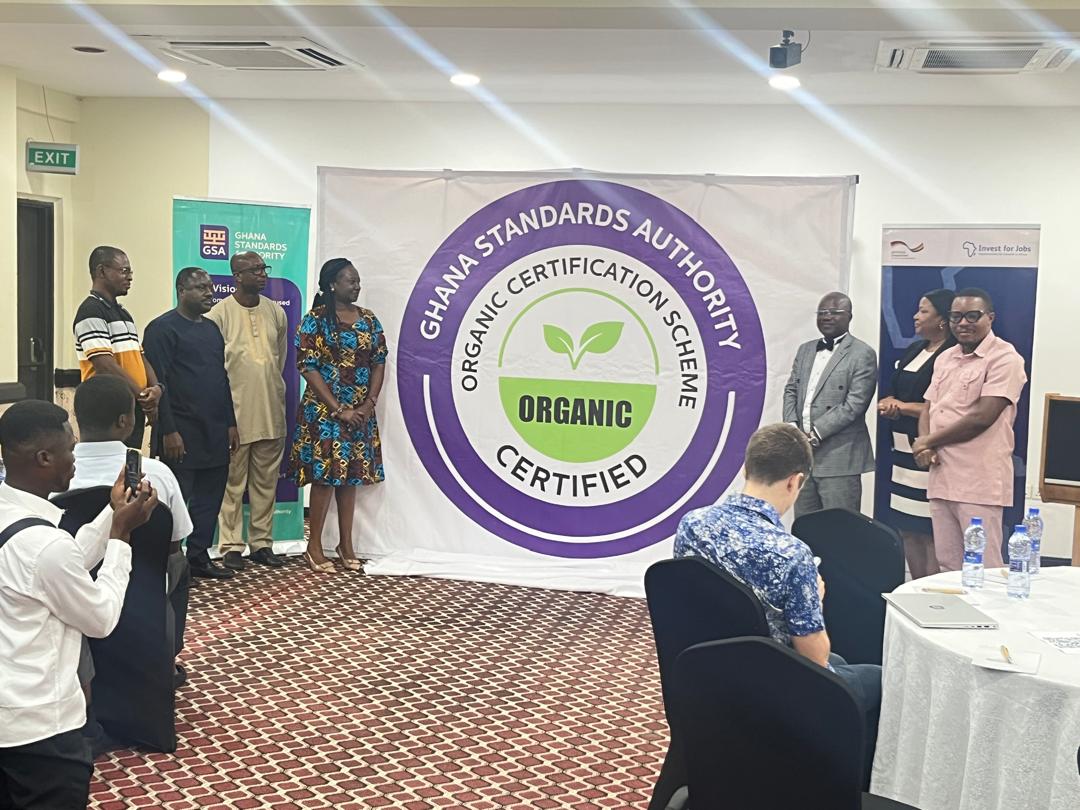
The Ghana Standards Authority (GSA), in collaboration with the German Development Cooperation, has unveiled an organic certification scheme and a testing regime for organic produce in Ghana.
The scheme is expected to enhance market access, improve compliance with international standards, and promote sustainable agricultural practices across the value chain.
Funded by the German Federal Ministry for Economic Cooperation and Development (BMZ) and implemented by the Deutsche Gesellschaft für Internationale Zusammenarbeit (GIZ) GmbH, the scheme is on the theme: “Advancing Sustainable Agriculture through Credible Organic Certification.”
Professor George Agyei, the Director-General of GSA, speaking at the event in Accra, indicated that the certification would ensure that the products were safe, reliable, and of high quality for both domestic and international markets.
The GSA Organic Certification Scheme is built on ISO/IEC 17065, the international standard for bodies certifying products, processes, and services.
It aligns with the European Union Organic Regulation 2018/848, which governs access to one of the world’s most demanding organic markets.
The scope covers crops, horticultural products, fruits and vegetables, and the commodities that define Ghana’s agricultural export identity.
Under the African Continental Free Trade Area, Prof Agyei said Ghana had an opportunity to become the preferred organic certification destination for the West African subregion.
“Our legal framework under the Standards Authority Act 2022, Act 1078, gives us the institutional mandate. Our location, our existing trade relationships, and our quality infrastructure give us the operational foundation,” he said.
“A farmer in Côte d’Ivoire, a processor in Senegal, and an exporter in Burkina Faso should be able to access GSA organic certification that is accepted in London, Brussels, and Tokyo.”
“This is what national standards bodies are for, not just to regulate, but to unlock. To build the infrastructure that makes trade possible, that makes quality visible, and that makes fairness enforceable.”
The global organic food and beverage market was valued at over 220 billion US dollars in 2024, and it is projected to exceed 380 billion dollars by 2030.
Europe alone accounts for more than a third of global organic consumption.
The EU’s farm-to-fork strategy targets 25 per cent of all agricultural land in the Union to be under organic farming by 2030.
Ms Eunice Agyeiwah Agyepong, Component Head, Invest for Jobs, GIZ Ghana, said the scheme would reduce the cost of organic certification since many businesses relied on foreign certification bodies.
She said the scheme would improve confidence in locally produced organic products and position Ghana as a credible supplier of high-quality organic products within Africa and beyond.
Mr Daniel Sowah, Assistant Industrial Officer, Ministry of Trade, Agribusiness, and Industry, said the scheme would address challenges of pesticides, which had been a bottleneck for some Ghanaian products.

